Home > Blog > How to Store Makhana in Bulk Without Losing Freshness
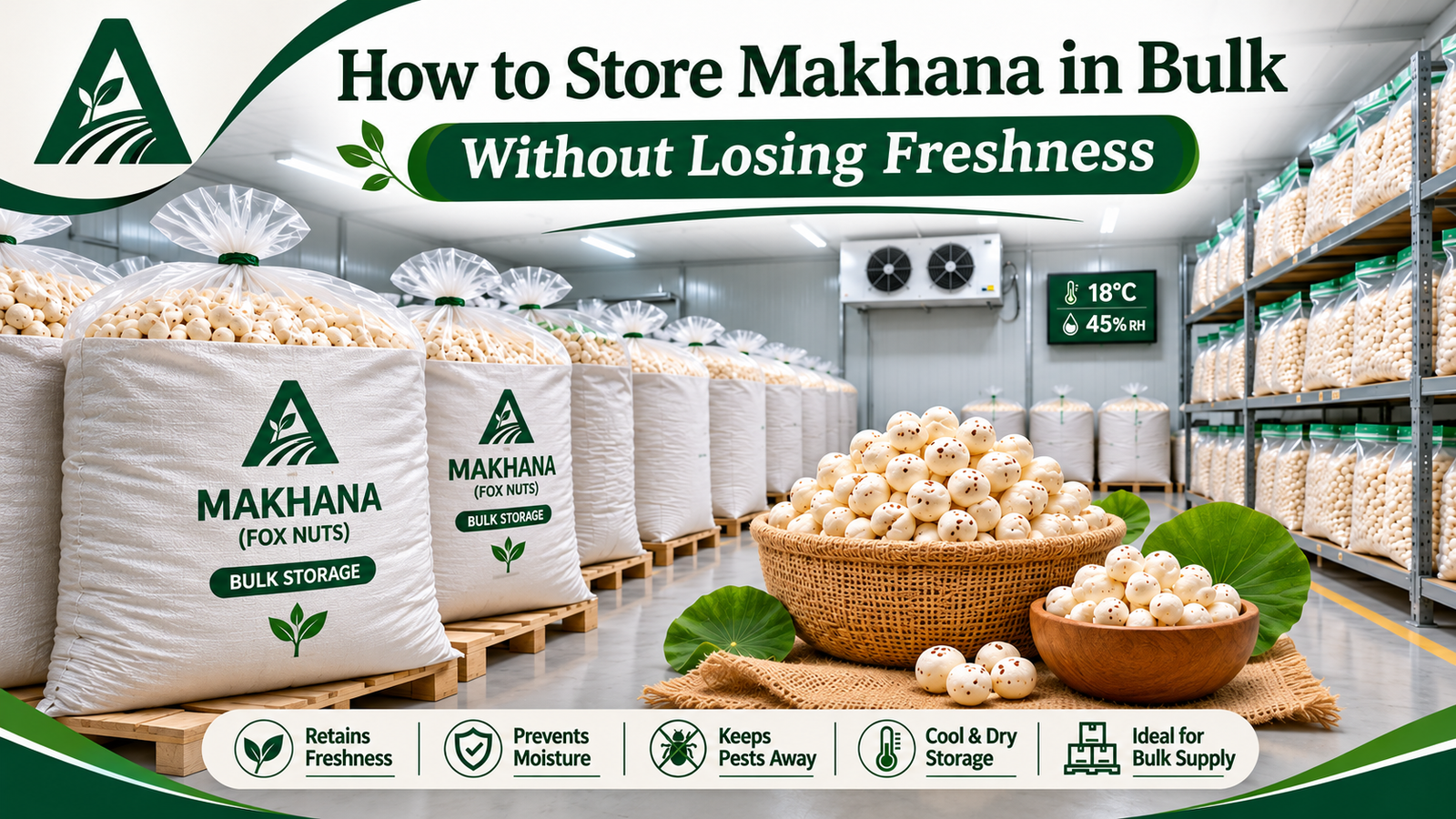
Buying makhana in bulk can be a smart business decision, especially for wholesalers, retailers, snack manufacturers, and food distributors. However, purchasing good-quality makhana is only half the job. The real challenge begins when you need to maintain its freshness, crunchiness, and overall quality during storage.
Imagine receiving a large shipment of fresh, crispy makhana, only to discover a few weeks later that some of it has become soft, stale, or unsuitable for sale. This can lead to unnecessary losses, disappointed customers, and reduced profit margins.
That is why understanding How to Store Makhana in Bulk Without Losing Freshness is essential for anyone involved in the makhana supply business.
Makhana, also known as fox nuts or lotus seeds in everyday trade terminology, is valued for its light texture and versatility. But its porous structure makes popped makhana sensitive to moisture in the surrounding environment.
Whether you store 50 kg, 500 kg, or several tonnes of makhana, the right storage practices can make a significant difference.
In this guide, we will explore practical methods to protect bulk makhana from moisture, heat, contamination, and packaging damage while maintaining its quality for customers.
When makhana is purchased in small quantities for household consumption, storage is relatively simple. A tightly closed container in a dry kitchen cabinet may be sufficient.
Bulk storage, however, requires greater attention.
Businesses often receive makhana in large bags or cartons and keep it in warehouses until it is sold, processed, or distributed. During this period, the product may be exposed to changing temperatures, humidity, repeated handling, and transportation-related damage.
Improper storage can affect makhana in several ways:
Loss of its characteristic crispy texture
Absorption of moisture from the surrounding air
Changes in taste and aroma
Increased breakage during handling
Risk of insects or contamination
Reduced marketability and customer satisfaction
For a retailer, these problems may result in customer complaints. For a wholesaler, they can affect an entire shipment.
Proper storage is therefore not simply about protecting food. It is also about protecting business investment.
The first rule of bulk makhana storage is simple: keep moisture under control.
Popped makhana readily interacts with moisture in the surrounding air. When exposed to humid conditions, it can gradually lose its light and crunchy texture.
This is particularly important in Indian cities where seasonal humidity changes significantly.
During the monsoon season, warehouses may experience damp conditions, especially where ventilation is inadequate or moisture enters through walls and floors.
To reduce moisture-related problems:
Keep makhana in properly sealed, moisture-resistant packaging.
Inspect warehouse walls, ceilings, and floors for dampness.
Avoid placing stock near leaking pipes or windows.
Monitor humidity where large quantities are stored.
Minimise unnecessary opening of bulk packages.
For commercial storage, a hygrometer can help monitor relative humidity. If humidity becomes excessive, suitable dehumidification or environmental controls may be necessary.
The key is to prevent the product from absorbing moisture rather than attempting to restore quality after damage has occurred.
Packaging plays an important role in maintaining freshness during storage and transportation.
A common mistake in bulk trading is assuming that any large bag is suitable for storing makhana.
In reality, packaging materials offer different levels of protection against moisture, air, dust, and physical damage.
Food-grade laminated bags with suitable moisture-barrier properties are a practical option for commercial makhana storage.
They help reduce exposure to environmental moisture when correctly sealed.
Airtight, moisture-resistant packaging is particularly important when makhana will remain in storage for an extended period.
Packaging should be checked for small punctures, weak seals, or damage before the stock enters the warehouse.
Makhana is lightweight but can break under excessive pressure.
Strong outer cartons can provide additional protection during stacking, loading, and transportation.
For commercial businesses, choosing suitable inner packaging and protective outer cartons helps preserve both freshness and physical appearance.
Research and food-processing guidance also recognise packaging and moisture management as important factors in makhana quality preservation.
The environment in which makhana is stored can be just as important as the packaging itself.
A warehouse may appear clean and organised but still experience excessive heat or humidity.
Ideally, bulk makhana should be stored in a location that is:
Dry and protected from water leakage
Away from direct sunlight
Protected from excessive heat
Clean and free from pest activity
Suitable for hygienic food storage
Avoid keeping makhana near boilers, heat-generating machinery, or areas exposed to strong afternoon sunlight.
Consistent storage conditions are preferable to frequent temperature fluctuations.
Warehouses should also be inspected regularly for condensation, damaged roofing, and signs of moisture penetration.
For businesses purchasing stock from the Best Makhana Supplier in Delhi, maintaining suitable warehouse conditions after delivery is an important responsibility.
Even carefully processed makhana can lose its desirable texture when stored improperly.
One of the simplest yet most effective warehouse practices is keeping packaged makhana off the floor.
Concrete floors can become damp, particularly during humid weather or after cleaning.
When bags remain in direct contact with the floor, there is a greater risk of moisture exposure and packaging contamination.
Use clean, dry pallets or suitable storage racks to elevate the stock.
Pallets also make it easier to inspect stored goods and maintain warehouse hygiene.
When arranging bulk makhana:
Keep packages on suitable pallets.
Maintain space between stock and warehouse walls.
Avoid placing bags near drainage areas.
Inspect pallets for moisture, dirt, or pest activity.
Follow safe stacking limits to prevent crushing.
Maintaining appropriate space around stock also supports cleaning and inspection.
These small operational practices can help reduce avoidable product losses.
Makhana has a delicate, airy structure. Although it is sold in bulk, it should not be handled like heavy grains or other dense agricultural commodities.
Excessive stacking can cause pressure damage, resulting in broken pieces and an inconsistent product appearance.
This becomes especially important for premium-grade makhana, where buyers often pay greater attention to size, uniformity, and the percentage of intact pieces.
To reduce breakage, use sturdy outer packaging and avoid overloading cartons.
Stack products according to the packaging manufacturer's recommendations, taking into account the weight and strength of the cartons.
Warehouse teams should also handle bags carefully during loading and unloading.
Throwing cartons, dragging bags across floors, or placing heavy materials on top of makhana can damage stock even when the packaging remains sealed.
Protecting physical quality is an important part of preserving commercial value.
Freshness management becomes much easier when stock movement follows a clear system.
The First-In, First-Out (FIFO) method involves dispatching older received inventory before newer inventory, where appropriate.
For example, suppose a wholesaler receives 200 kg of makhana in the first week of a month and another 300 kg two weeks later.
If the newer stock is repeatedly dispatched first, the earlier shipment may remain in storage longer than necessary.
Over time, this increases the possibility of quality deterioration.
A better approach is to label each batch with its receiving date and maintain an inventory record.
Where products have different best-before dates, First-Expiry, First-Out (FEFO) is generally more appropriate.
A simple inventory record should include:
|
Inventory detail |
Information to record |
|---|---|
|
Batch number |
Unique batch identification |
|
Receipt date |
Date stock entered the warehouse |
|
Quantity |
Total quantity received |
|
Packaging condition |
Intact or damaged |
|
Best-before date |
As declared for the product |
|
Inspection status |
Quality-check observations |
This system improves stock traceability and reduces the chance of older inventory being overlooked.
Not all makhana products require identical storage procedures.
Plain popped makhana, roasted makhana, flavoured snacks, and unpopped raw seeds differ in their processing, composition, and storage requirements.
For instance, flavoured makhana may contain oil, ghee, salt, or seasoning ingredients that influence its shelf life.
Plain makhana is especially sensitive to moisture-related loss of crispness, while seasoned products can also experience changes in flavour and aroma.
Unpopped makhana seeds should not automatically be stored using the same methods as popped makhana.
Businesses handling multiple product categories should keep separate, clearly labelled inventory batches.
This reduces confusion and makes it easier to follow the relevant manufacturer's storage instructions.
It is also advisable to keep strongly aromatic products away from makhana to minimise the risk of unwanted odour transfer.
Warehouse inspections should be part of routine business operations rather than something done only when a customer complains.
Periodic checks can help identify packaging problems, pest activity, or environmental issues before they affect a larger quantity of stock.
During inspection, observe the following:
Appearance: Check whether makhana has developed unusual discolouration, visible contamination, or other unexpected changes.
Texture: Examine representative samples for loss of crispness, where sampling is permitted.
Smell: Investigate any musty, sour, or unusual odour.
Packaging: Look for torn bags, broken seals, damp patches, or signs of insects.
Storage conditions: Review temperature, humidity, cleanliness, and stacking arrangements.
If a batch shows signs of mould, pest infestation, or contamination, isolate it immediately for appropriate quality assessment.
Do not mix questionable stock with fresh makhana or attempt to disguise its condition through roasting.
A documented inspection routine can protect customers and help businesses maintain consistent product standards.
Monsoon storage deserves special attention because humidity can rise significantly during prolonged rainy periods.
Even a warehouse that performs well during winter may face moisture-related challenges during the rainy season.
Some practical monsoon precautions include checking roofs and walls for leaks before the season begins, maintaining functional drainage, inspecting seals, and monitoring humidity more frequently.
Avoid opening bulk packaging unnecessarily when the surrounding air is humid.
If an opened bag cannot be used immediately, transfer the remaining product into suitable food-grade, moisture-resistant packaging and seal it properly.
Businesses handling large quantities may benefit from dedicated dry-storage arrangements.
Preventive maintenance is generally easier and less expensive than managing a large shipment that has already suffered moisture damage.
There is no single shelf-life figure that applies to every type of makhana.
Freshness depends on several factors, including the initial condition of the product, processing method, moisture content, packaging quality, and storage environment.
Plain popped makhana and ready-to-eat flavoured makhana may have different best-before periods.
Commercial products may remain suitable for several months under appropriate conditions, but the exact period should be supported by product-specific shelf-life assessment rather than a general assumption.
Always follow the declared best-before date, supplier documentation, and applicable food-safety requirements.
A sealed package does not guarantee freshness if it has been exposed to excessive heat, moisture, or physical damage.
Regular quality inspections remain necessary throughout the storage period.
Good storage practices begin before the product reaches your warehouse.
If makhana has already been exposed to moisture, handled poorly, or packed inadequately, even the best warehouse arrangements may not fully protect its quality.
This is why supplier selection is an important part of successful bulk purchasing.
When searching for the Best Makhana Supplier in Delhi, businesses should evaluate suppliers based on product quality, transparent grading, suitable packaging, and consistency across shipments.
Before placing a bulk order, consider asking:
Is the makhana freshly processed and properly packed?
Are size and grade details clearly communicated?
Can the supplier provide representative samples?
Is the packaging suitable for the intended transportation and storage period?
Are batch identification and relevant product details available?
For wholesalers, retailers, and snack businesses sourcing makhana in large quantities, a dependable supply arrangement can reduce uncertainty and support better stock planning.
Businesses exploring bulk procurement can visit AgroTerminus to learn more about makhana sourcing and supply options.
Choosing a reliable supplier and maintaining proper storage practices should work together, rather than being treated as separate decisions.
Many storage problems arise from ordinary practices that initially appear harmless.
Leaving partially opened bags unattended, placing stock beside damp walls, or ignoring damaged packaging can gradually affect product quality.
Another mistake is buying significantly more inventory than the business can reasonably sell within its planned turnover period.
While larger orders may appear economical, excess stock can increase storage costs and exposure to quality-related risks.
Businesses should avoid relying solely on visual appearance to judge freshness.
A product may look acceptable but still have an undesirable texture or flavour.
Similarly, repeated roasting should not be considered a reliable solution for potentially spoiled stock.
The better approach is to establish preventive storage procedures, inspect batches routinely, and purchase quantities aligned with actual demand.
Maintaining freshness does not always require complicated warehouse technology.
A practical operating routine can significantly improve day-to-day stock management.
When a shipment arrives, inspect the packaging, verify product details, and record the batch information.
Move accepted goods into a clean, dry storage area and place them on appropriate pallets or racks.
During storage, monitor environmental conditions and check for moisture, damaged packages, or pest activity.
Before dispatch, verify that the selected batch is suitable for sale and that its packaging remains intact.
Finally, maintain clear records of incoming and outgoing stock.
This approach supports better inventory control, product consistency, and accountability across the supply chain.
For businesses that handle makhana regularly, these procedures can become an important part of everyday quality management.
Knowing How to Store Makhana in Bulk Without Losing Freshness is not just a warehouse-management skill. It is an essential part of maintaining customer satisfaction and protecting the value of every shipment.
Moisture control, suitable packaging, careful handling, clean storage conditions, and proper stock rotation all contribute to preserving makhana quality.
Businesses should also remember that freshness begins with sourcing. Buying properly processed and packaged makhana from a dependable supplier gives storage efforts a stronger starting point.
Whether you are a wholesaler, retailer, distributor, or snack manufacturer, consistent storage practices can help reduce avoidable wastage and maintain product quality.
If you are looking for bulk makhana sourcing options, explore AgroTerminus and discuss your requirements before purchasing.
VISIT HOME - https://agroterminus.com/
Because in the makhana business, maintaining freshness is just as important as buying quality.

