Home > Blog > Bulk Makhana Buying Guide for Retailers, Distributors & Food Businesses
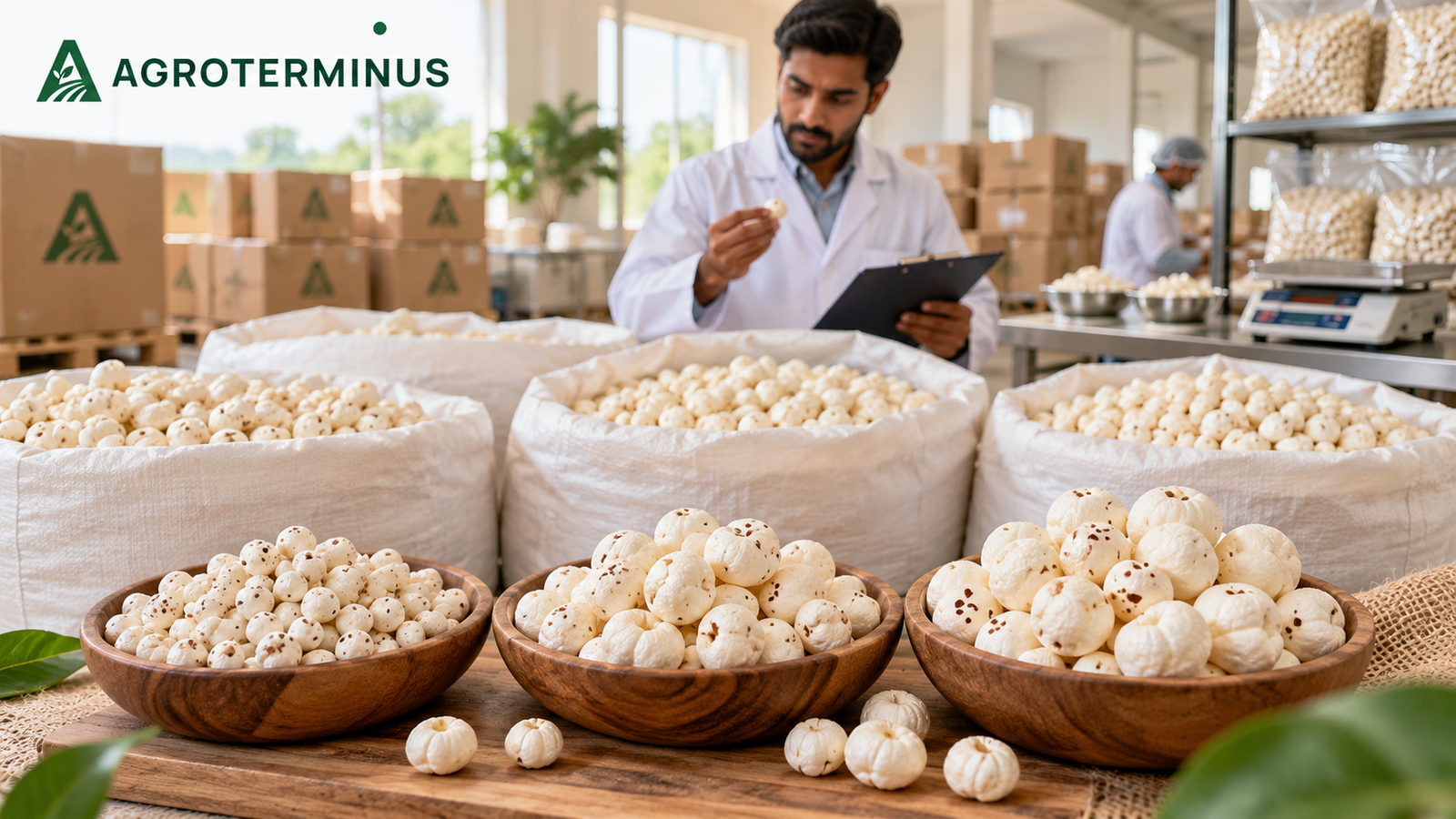
Buying makhana in bulk might seem straightforward at first. You contact a supplier, compare prices, place an order, and wait for delivery. But anyone who has handled wholesale food products knows that the reality is often more complicated.
Two batches of makhana can look similar in photographs but perform very differently when they reach your store or production facility. One may contain beautifully expanded, uniform pieces, while another may have excessive breakage, inconsistent sizes, or moisture-related problems.
For a retailer, these differences can influence customer satisfaction. For a distributor, they can affect resale value and inventory movement. And for a snack manufacturer, they can change roasting results, seasoning performance, and production efficiency.
That is why choosing the right bulk makhana supplier in India is about more than finding an attractive price.
Whether you are launching a healthy snack brand, stocking a dry fruit store, managing a supermarket supply chain, or purchasing raw makhana for food processing, understanding the product before buying is essential.
This complete bulk makhana buying guide explains how to evaluate grades, quality, wholesale pricing, packaging, supplier reliability, and storage so that you can make better purchasing decisions for your business.
Makhana, also known as fox nuts or popped gorgon nuts, has been part of Indian food traditions for generations.
It is commonly enjoyed roasted, seasoned, or prepared in dishes such as kheer, curries, and traditional snacks.
For modern food businesses, its versatility creates several possibilities. Retailers can offer plain makhana alongside dry fruits and snacks. Food brands can develop roasted and flavoured varieties. Distributors can serve supermarkets, independent retailers, and institutional buyers.
One advantage is that the same base product can serve different customer preferences through suitable grading, preparation, and packaging.
However, this flexibility does not mean every makhana grade is appropriate for every business.
A premium gifting brand may prioritise larger, visually attractive pieces, while a food processor may focus more on uniform roasting performance and practical cost.
Understanding your own business requirements is therefore the first step in buying makhana wholesale.
Before approaching a wholesale makhana supplier, decide how you intend to use the product.
Are you buying raw popped makhana for resale? Will you roast and season it under your own brand? Do you need a premium variety for gifting packs? Or are you a distributor supplying several retail outlets?
These questions matter because they influence the grade, quantity, packaging format, and quality standards you should request.
For example, a small retailer may want manageable quantities and dependable replenishment. A distributor may prioritise uniform grading and consistent packaging across repeated orders.
A snack manufacturer needs a product that performs predictably during processing.
Prepare a simple buying brief covering your intended use, preferred grade, approximate quantity, packaging preference, delivery location, and expected purchase frequency.
When you share these details with a supplier, the discussion becomes more productive.
Instead of receiving a generic quotation, you can compare options that match your actual business needs.
One of the most important decisions in wholesale makhana purchasing is selecting the correct size grade.
The word Suta is commonly used in the makhana trade to describe size categories. Larger-sized makhana generally has a different market positioning from smaller-sized varieties.
However, size classification can vary among suppliers, so buyers should confirm the grading specifications rather than relying only on the name.
Basun Makhana by AgroTerminus offers three principal makhana grades:
4 Suta is a smaller-sized makhana grade that can be useful for value-focused snack products and food preparations where large individual pieces are not necessary.
For businesses working with a particular cost structure, this grade may offer a practical option.
It can be considered for selected roasted snacks, recipes, and processing applications, depending on quality and customer expectations.
5 Suta occupies a middle position in the size range.
It can appeal to retailers and food brands seeking a balance between visual appearance, product size, and purchasing cost.
For businesses developing a regular makhana product line, this grade may be worth sampling.
Its suitability should be assessed through actual product testing and comparison with the intended retail price.
6 Suta contains larger-sized pieces and is generally associated with premium product positioning.
It may be useful for luxury snack packaging, dry fruit assortments, gifting products, and other applications where appearance is especially important.
Larger size alone does not guarantee superior quality. Buyers must still evaluate cleanliness, moisture, texture, breakage, and consistency.
| Grade | Approximate Size | Potential Business Use |
|---|---|---|
| 4 Suta | 13 mm | Value-focused snacks and selected food applications |
| 5 Suta | 16 mm | General retail packs and roasted snack products |
| 6 Suta | 20 mm | Premium retail, gifting and large-size product ranges |
The most profitable option is not necessarily the largest grade. It is the grade that delivers the right combination of quality, customer acceptance, and cost for your business.
Product quality deserves careful attention because even a small difference can become significant when you purchase hundreds of kilograms.
An attractive sample should never be your only basis for placing a large order.
Start by checking the overall appearance.
Good-quality makhana should be reasonably uniform for the declared grade, without excessive visible dirt, foreign material, or damaged pieces.
Colour may naturally vary, but unusual discolouration deserves attention.
Next, inspect the level of breakage.
Some broken pieces are expected during handling and transportation. Excessive breakage, however, may affect retail presentation or reduce usable yield for certain applications.
Size consistency: Confirm whether the batch matches the grade being purchased.
Cleanliness: Look for dust, foreign particles, and other unwanted material.
Breakage percentage: Ask how much broken product is acceptable under the agreed specification.
Smell: The product should not have an unusual musty or stale odour.
Texture: Assess the product after appropriate roasting or preparation, since raw popped makhana can differ from a ready-to-eat roasted snack.
Moisture: Request moisture specifications and relevant testing information where necessary.
Batch consistency: Understand how the supplier manages grading and quality across different lots.
For commercial buyers, a written product specification is useful. It makes expectations clearer and can reduce disagreements after delivery.
Bihar has a strong historical connection with makhana cultivation and processing.
Its traditional makhana-producing regions have developed specialised knowledge related to cultivation, collection, processing, and trade.
For businesses looking to buy makhana in bulk, supply-chain traceability can be valuable.
Knowing the origin of the product may help buyers understand the sourcing network and ask more specific questions about processing, grading, and handling.
However, sourcing from Bihar should not be treated as an automatic guarantee of quality.
The final product still needs appropriate selection, processing, storage, and inspection.
AgroTerminus highlights its connections with Bihar's makhana-growing region and its focus on direct sourcing and long-term supplier relationships.
For retailers and distributors operating in Delhi NCR, discussing supply requirements with a Delhi-based company that maintains sourcing connections in Bihar can be a practical starting point.
One of the most searched questions among commercial buyers is: What is the makhana wholesale price in India?
There is no single price that applies to every grade, supplier, location, or order.
Makhana prices can vary because of several factors.
Larger makhana grades may command higher prices because of grading differences and market preferences.
Nevertheless, actual quotations depend on the quality and availability of the specific lot.
Cleanliness, sorting, uniformity, breakage, and processing standards can influence the price.
Some suppliers may offer different pricing structures for larger purchases.
Always confirm the minimum order quantity and whether quantity-based pricing is available.
Bulk bags, smaller retail packs, specialised packaging, and private-label formats have different cost implications.
Freight charges depend on the shipment size, dispatch location, delivery destination, and transport arrangement.
Seasonal availability, demand, procurement conditions, and inventory levels can also influence pricing.
When comparing quotations, request the same grade, quality specification, quantity, and delivery terms from each supplier.
Otherwise, the lowest quoted rate may not represent the best value.
A wholesale quotation tells you the purchase price, but it does not always reveal the complete cost of the product once it reaches your business.
Consider an illustrative example.
Suppose a food business purchases 100 kg of makhana at an assumed rate of ₹500 per kg.
The basic purchase value is ₹50,000.
If transportation, handling, and other non-tax expenses total ₹3,000, the landed cost becomes ₹53,000, or ₹530 per kg before accounting for any unusable product.
Now imagine that inspection and processing leave only 96 kg suitable for your intended product.
The effective cost per usable kilogram becomes approximately ₹552.
These numbers are hypothetical and are not current AgroTerminus quotations.
The example shows why freight, damage, processing losses, and usable yield matter when comparing suppliers.
For snack manufacturers and repackaging businesses, this calculation can be particularly valuable.
Retailers usually look for products that customers recognise, find appealing, and can purchase conveniently.
If you operate a dry fruit shop, supermarket, or neighbourhood grocery store, consider how makhana fits within your existing product range.
Customers may prefer smaller packs for occasional snacking, while regular buyers may choose larger family packs.
Packaging should clearly explain what is being sold, including grade or product type where relevant.
For businesses selling plain popped makhana, freshness and product appearance are important.
Retailers should also review shelf-life information, storage instructions, and food labelling requirements before offering packaged products for sale.
If you are developing a private brand, choose a grade that supports consistent product appearance from one production batch to another.
Distributors face a different challenge from retailers.
Their responsibility is not simply to purchase stock. They must also maintain predictable inventory and serve multiple downstream customers.
A distributor dealing with different shops may need more than one makhana grade.
Some customers may prefer affordable everyday varieties, while others focus on premium products.
Before placing a large order, review the sales history and expected demand of your buyers.
Consider whether maintaining separate grades will improve sales or unnecessarily increase inventory complexity.
A dependable wholesale supplier should be able to discuss product specifications, stock availability, packaging, order schedules, and dispatch arrangements clearly.
It is also useful to confirm how damaged goods, short deliveries, and quality disputes will be addressed.
Long-term distribution relationships work best when expectations are documented and communication is consistent.
Makhana is a versatile ingredient for food businesses developing roasted and flavoured snacks.
Popular product concepts include lightly salted makhana, peri-peri flavoured makhana, masala makhana, pepper-flavoured snacks, and other seasoned varieties.
However, successful snack manufacturing requires more than choosing an attractive flavour.
The size and condition of the raw popped makhana can affect roasting uniformity, breakage, seasoning distribution, and final texture.
For example, a batch containing widely mixed sizes may require additional sorting to achieve consistent processing results.
Before committing to a large volume, carry out small production trials.
Test the selected grade using your intended roasting method, seasoning process, packaging material, and storage conditions.
Measure the finished product's usable yield and assess how well its crispness holds during the planned shelf life.
This provides more reliable information than selecting a grade based only on appearance.
Packaging plays an important role in maintaining product quality during storage and transportation.
Makhana can be affected by moisture exposure, physical pressure, and poor handling.
The right packaging should help protect the product from these conditions.
For bulk distribution, sturdy food-grade packaging with suitable sealing and protection is important.
For consumer retail packs, the packaging should also support shelf presentation, product information, and convenient use.
Businesses developing branded packs may explore appropriate barrier packaging to help maintain product quality.
However, packaging choices should be validated against actual shelf-life requirements rather than selected solely for appearance.
If you are purchasing raw material for further processing, discuss the available packaging formats with your supplier before ordering.
Poor storage can reduce the value of a good-quality bulk purchase.
A warehouse that is damp, poorly ventilated, or exposed to pests creates unnecessary risks for food products.
Store makhana in a clean, dry area away from moisture, strong odours, direct sunlight, and unsuitable temperature conditions.
Keep packages sealed according to the supplier's instructions and avoid placing stock directly on the floor.
A first-expiring, first-out inventory system can help businesses manage products according to their shelf-life dates.
Inspect stock periodically for damaged packaging, unusual odours, moisture exposure, or pest activity.
For larger businesses, documented receiving and storage procedures can improve traceability and reduce waste.
Always follow the storage and shelf-life conditions established for the specific product.
Food businesses purchasing makhana wholesale should pay attention to applicable regulatory requirements.
In India, businesses engaged in food manufacturing, storage, distribution, and sale may require suitable FSSAI registration or licensing, depending on their activity and eligibility.
Packaged food products must also comply with applicable labelling rules.
Depending on the product and business arrangement, relevant details can include ingredient information, net quantity, batch identification, manufacturer or packer details, best-before information, and other mandatory declarations.
Retailers and food brands should verify the requirements that apply to their specific products.
For larger or specialised purchases, buyers may also request applicable food safety documentation, product specifications, and relevant testing records from suppliers.
If your business plans to export makhana, additional destination-specific standards and documentation may apply.
Regulatory compliance should be checked independently rather than assumed from a supplier's marketing description.
Choosing a supplier is one of the most important decisions in building a reliable makhana business.
A supplier may offer attractive prices, but the relationship should also provide clarity and consistency.
Before confirming an order, ask about the current grade availability, size specifications, packaging, sample policy, minimum order quantity, and delivery arrangements.
Discuss how prices are quoted and whether freight is included.
Ask how the supplier handles unexpected stock shortages or quality concerns.
It is also worth confirming whether you will receive the same grade specification during repeat orders.
These discussions may feel time-consuming initially, but they help prevent misunderstandings later.
For retailers and food manufacturers planning regular purchases, clear communication can be just as valuable as an attractive price.
One common mistake is choosing the cheapest available quotation without comparing product quality.
Another is ordering large quantities before testing how the product performs in the intended application.
Some buyers focus entirely on size and overlook cleanliness, moisture, packaging, and transport damage.
Others fail to clarify whether the quoted price includes transportation and additional handling charges.
Food businesses may also make the mistake of purchasing too much stock without planning suitable storage.
Avoid these problems by starting with a clear specification, inspecting samples, understanding the complete landed cost, and confirming the supply terms in writing.
A well-informed purchase can support smoother operations and reduce preventable losses.
When searching for a wholesale makhana supplier in Delhi, businesses often look for product variety, sourcing information, and a supplier that understands commercial requirements.
Basun Makhana by AgroTerminus focuses on supplying makhana sourced through its Bihar connections to retailers, distributors, wholesalers, and food businesses.
The company offers 4 Suta, 5 Suta, and 6 Suta makhana grades to serve different product and market requirements.
Its Delhi business location makes it a relevant supplier to explore for buyers in the capital region.
AgroTerminus also emphasises responsible sourcing, product selection, and long-term business relationships.
Businesses can contact the team to discuss their preferred grade, quantity, packaging requirements, and current wholesale availability.
The website's wholesale enquiry form specifies a minimum order criterion of 10 bags or 1,500 packets of 200 g. Buyers should confirm the applicable minimum, bag weights, and packaging arrangement for their order.
You can explore wholesalers and suppliers that handle commercial makhana quantities in Delhi NCR. AgroTerminus, based in Dwarka, New Delhi, accepts bulk enquiries from retailers, distributors, and food businesses.
The most suitable grade depends on your customers and pricing strategy. 5 Suta can be considered for mainstream retail products, while 6 Suta may be suitable for premium positioning. Always compare samples before selecting a grade.
These are size-related trade classifications. AgroTerminus lists 4 Suta at approximately 13 mm, 5 Suta at 16 mm, and 6 Suta at 20 mm. Larger grades generally have larger pieces, but product quality should be assessed separately.
Wholesale prices depend on grade, quality, quantity, packaging, market availability, and freight arrangements. Buyers should request quotations based on clearly defined specifications.
Yes. Food businesses can source makhana for roasting, seasoning, packaging, and other suitable applications. Sample testing and compliance with applicable food regulations are important.
Not necessarily. Larger makhana may suit premium retail products, while smaller or medium-sized grades can be appropriate for other applications. The correct choice depends on intended use, specifications, and cost.
Keep it in clean, dry, suitable storage conditions, protected from moisture, pests, strong odours, and packaging damage. Follow the storage and shelf-life information supplied for the product.
Packaging options depend on the supplier and the nature of the order. Buyers should discuss bulk bags, retail packs, and other requirements before finalising a purchase.
The AgroTerminus website currently states wholesale enquiry criteria of 10 bags or 1,500 packets of 200 g. Confirm the current terms directly before ordering.
Compare samples, grading consistency, product specifications, packaging, documentation, pricing transparency, and delivery terms. A supplier who communicates clearly and supports repeat-order consistency is worth considering.
A successful makhana business starts with understanding the product you are purchasing.
Whether you operate a retail shop, manage a distribution network, or manufacture roasted snacks, the right buying decisions can improve product consistency, customer satisfaction, and inventory management.
Focus on the grade that suits your target market. Inspect quality carefully. Compare complete purchasing costs rather than only the quoted price per kilogram. And work with suppliers who can explain their specifications and supply arrangements clearly.
If your business is looking to buy makhana in bulk from a supplier with sourcing connections in Bihar and a presence in Delhi, explore the options available through Basun Makhana by AgroTerminus.

